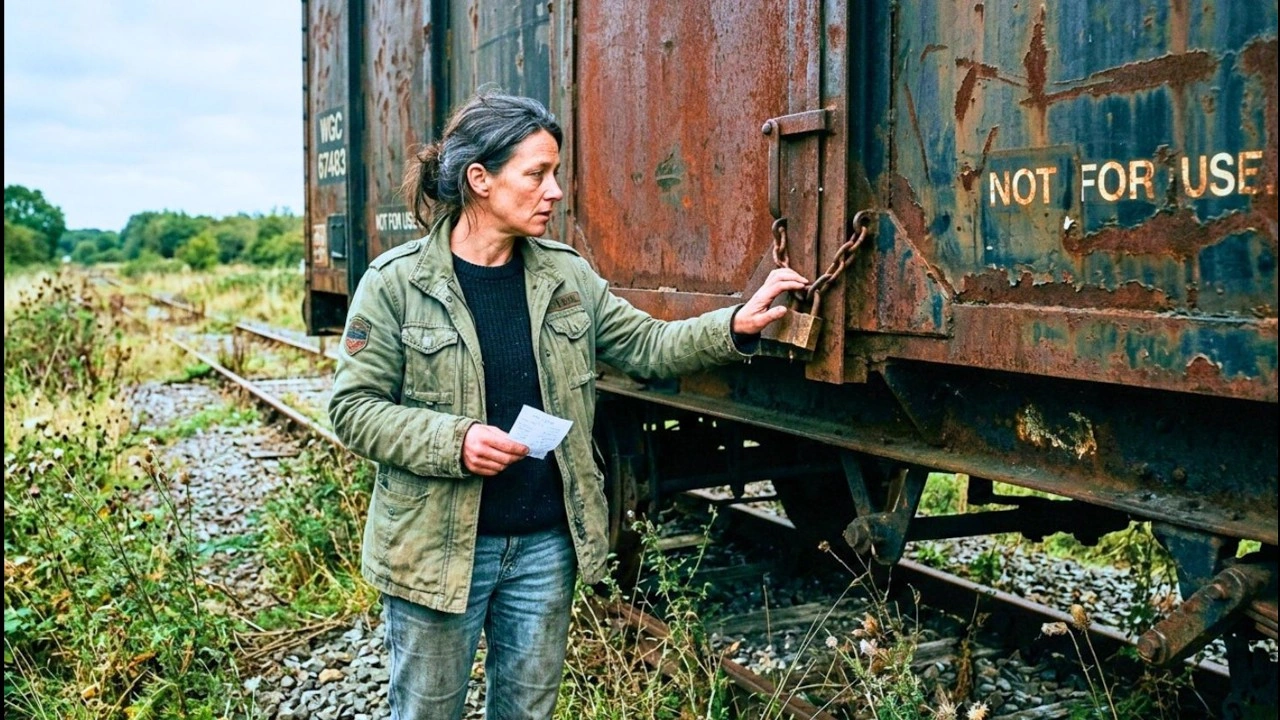
At 67 years old, Cecile Pruitt stood in the middle of a muddy salvage yard in Clarksburg, West Virginia, with just $8 in her coat pocket and nearly everything she owned stuffed inside a garbage bag.
Three days earlier, her life had fallen apart.
Now she was staring at something nobody else seemed to want: an old, rust-covered train car secured by a heavy padlock and said to have remained unopened for generations.
Cecile didn’t know what was inside.
She didn’t even know exactly why she wanted it.
But when the bidding began, she raised her hand.
Eight dollars.
It seemed like a desperate purchase made by a woman who had almost nothing left.
What happened afterward, however, would turn Cecile’s life in a direction she never could have imagined.
But to understand why an abandoned train car mattered so much, you first have to understand how Cecile ended up in that salvage yard with only eight dollars to her name.
A Life Built on Hard Work
Cecile was born and raised in Clarksburg, West Virginia, the second of four children in a working-class family.
Money was always tight.
Her father worked on the railroad, while her mother cleaned houses and took in laundry to help keep food on the table.
Cecile learned early that dignity wasn’t measured by how much money you had. In her family, it came from working hard, keeping your word, and refusing to give up when life became difficult.
Those lessons stayed with her.
She married young.
Her husband, Gerald Pruitt, was a quiet, hardworking man employed at a local lumber mill. He loved crossword puzzles, strong coffee, and the simple life they were building together.
They were never wealthy.
But after years of careful saving, Gerald managed to buy a modest two-bedroom house on Canary Street.
To Cecile, it felt like a palace.
It was theirs.
Soon, their family grew.
Their son Brandon was born in 1978. Even as a boy, he was serious and ambitious, always talking about leaving Clarksburg and building a bigger life somewhere else.
Three years later came Tamara.
She was completely different from her brother—outspoken, confident, and remarkably good at talking her way into opportunities.
Cecile adored them both.
And for years, almost every decision she made revolved around giving her children opportunities she had never had herself.
Then Everything Began to Change
Gerald was a good husband and father, but his health gradually deteriorated.
Chronic back problems became increasingly severe during his forties. Eventually, he could no longer continue working at the lumber mill.
The family lost a major source of income.
Then came the medical bills.
At first, they were manageable.
Then they seemed to arrive faster than Cecile could pay them.
She responded the only way she knew how.
She worked.
And then she worked some more.
Cecile began taking the early shift at a roadside diner, arriving before sunrise to prepare for the morning customers.
Several afternoons each week, she left the diner and cleaned offices for a property management company.
She maintained that exhausting routine for 11 years.
Her children rarely understood how close the family came to financial disaster.
Cecile made sure they didn’t.
When Brandon needed new shoes for school, somehow there was money for shoes.
When Tamara needed textbooks or a dress for a school event, Cecile found a way.
Sometimes that meant Cecile went without.
She stretched groceries as far as possible. She postponed replacing clothes. She wore the same winter coat long after it had begun showing its age.
There were even times when she ate less so another bill could be paid.
But she rarely complained.
Her reasoning was simple:
Her children had a chance to build better lives.
And she wasn’t going to stand in their way.
Her Children Left Clarksburg Behind
Eventually, Cecile’s sacrifices appeared to pay off.
Brandon performed well in school and earned a partial scholarship to study business in Ohio.
He left Clarksburg and began building the future he had always imagined.
Over time, however, the distance became more than geographical.
Brandon developed a successful career in corporate finance, married, and settled into a comfortable suburban life.
Visits home became less frequent.
Phone calls became shorter.
Birthdays and Christmas increasingly became the only occasions when Cecile could expect to hear from him.
Tamara also left home and created a successful life of her own.
She attended cosmetology school and eventually built a thriving salon business in Charleston.
She married twice, and as her lifestyle changed, Cecile increasingly felt as though she belonged to a different world from the one her daughter now inhabited.
Still, Cecile remained proud of them.
After everything she had sacrificed, seeing her children succeed was supposed to make those difficult years worthwhile.
Then, in 2014, Cecile suffered the loss that changed everything.
Goodbye to Gerald
After 31 years of marriage, Gerald died quietly at home.
Cecile was beside him.
She held his hand as the man with whom she’d built her entire adult life slipped away.
Then came another painful reality.
The funeral had to be paid for.
Cecile’s finances were already stretched thin, and even arranging a modest service proved difficult.
She eventually borrowed $400 from a neighbor to help cover the cost of Gerald’s casket.
Brandon and Tamara attended their father’s funeral.
They hugged their mother.
They stood beside her at the graveside.
They said goodbye to Gerald.
And within two days, both had returned to their own lives.
Cecile returned to the little house alone.
For the first time in decades, there was nobody waiting for her when she opened the front door.
No Gerald sitting with a crossword puzzle.
No children running through the hallway.
Just silence.
She had spent much of her life making sure everyone else was taken care of.
Now she was approaching old age and beginning to discover a frightening truth:
There might be nobody left to take care of her.
The Day Cecile Had Nowhere Left to Go
The years following Gerald’s death were not kind.
Money became tighter. Problems accumulated. And the relationship between Cecile and her children deteriorated.
Eventually, the woman who had once worked two jobs to give Brandon and Tamara better lives found herself being treated as something she never imagined she would become:
A burden.
Then came the breaking point.
Cecile found herself without a home and with almost nothing left to her name.
Everything important enough to carry had been pushed into a garbage bag.
Inside her coat pocket were eight dollars.
That was it.
Three days later, Cecile wandered into a county salvage auction in Clarksburg.
Most people there were searching for equipment, scrap metal, tools, or anything they might be able to repair and resell.
Cecile couldn’t afford any of it.
Then she noticed the train car.
It sat forgotten at the edge of the property, covered in rust and seemingly useless.
The door was secured with an ancient-looking padlock.
Nobody appeared particularly interested in it.
Except Cecile.
When the auctioneer finally reached the unwanted railcar, there was almost no enthusiasm from the crowd.
Cecile reached into her coat pocket.
She felt the few bills she had left.
And she made a decision that made absolutely no financial sense.
She bid.
Eight dollars.
Nobody challenged her.
The train car was hers.
At that moment, Cecile had no idea whether she’d just spent her last eight dollars on worthless rust.
But there was something behind that locked door.
Something that apparently had been sitting undisturbed for an extraordinary amount of time.
And when the old lock was finally opened, Cecile would discover that the most unwanted object in the salvage yard might not have been worthless after all.
In fact, what was waiting inside would change everything.